Beáta’s Report on the Kőrösi Csoma Sándor Program Website:
IV. Hawaii Diaspora School Camp
Experiences and Hungarian Identity Strengthening
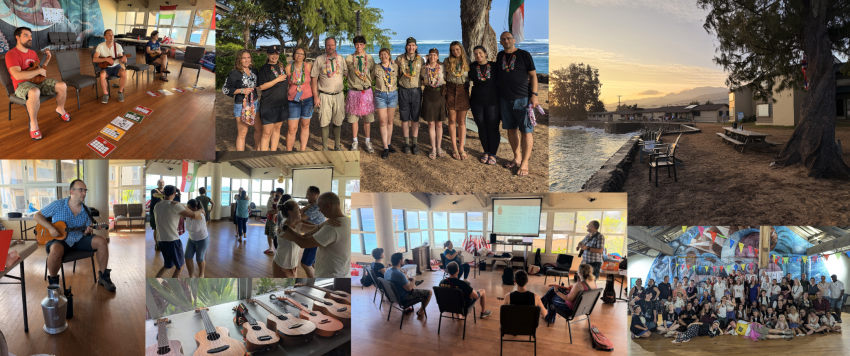
The IV. Hawaii Diaspora School Camp took place November 26–30, 2025, during the Thanksgiving period, on the northern shore of Oahu island, at the Mokuleia Camp. Participants came not only from Hawaii but from many parts of the United States, including California, Oregon, North Carolina, Virginia, Washington D.C., and New York. This geographic diversity created a particularly fitting environment for Hungarian diaspora communities to meet and learn together.
I participated in the camp as an organizing assistant, and was also responsible for the professional implementation of the music and dance programs. Representing the Crossroads Band and the Crossroads Music and Arts Foundation, Attila Egyedi and I co-led these sessions. Each day of the week included separate folk dance instruction for children and adults, as well as regular music sessions.
In assembling the dance material, diversity and experiential learning were key priorities. The children learned Moldavian and Felcsík circle dances, while the adults learned Szék dances, and both groups also got a taste of the basic steps of Roma dances. Despite many participants coming from bilingual families with varying levels of Hungarian, dance provided an opportunity for connection and shared experience.
The music sessions were built around Hungarian folk songs, complemented by a few Romani folk songs. Rhythm exercises and rhythm games were woven into every session — including rhythmic clapping, finger-snapping, mouth bass, can-playing, and spoon-playing. These methods not only developed musical skills but also supported concentration, cooperation, and mutual attentiveness. The music sessions also included ukulele instruction, which — through the instrument itself — connected both to local Hawaiian culture and to the Hungarian song repertoire. The ukulele is an instrument that yields a sense of accomplishment relatively quickly, so participants were able to join in the group music-making without delay. Instrumental accompaniment allowed the songs learned to come to life in a new musical context, while both children and adults participated as active creators. The results of the music and dance work were showcased at the closing gala, where participants performed together what they had learned throughout the week.
Alongside the instructional work, we also led campfire singing each evening, where making music together provided relaxation for the adults while creating intimate, nostalgic, and bonding moments.
The camp program was further enriched by craft sessions and an overarching narrative framework. The 2025 theme was built around the animated film Szaffi, which guided participants through a five-day treasure-hunt story. Within that story, the iconic route of Hungary’s Blue Trail appeared, with waypoints leading through various regions and landscapes of Hungary. Tied to this narrative, a wide variety of craft activities took place — including basket weaving, clay modeling, pottery, porcelain making, embroidery, satchel weaving, jewelry making, and printing in the style of the Vizsoly Bible. These activities connected the story, Hungarian cultural heritage, and hands-on creative work in a tangible, experiential way.
Recognition and thanks for making the camp happen go to Ágnes Törteli, who as lead organizer provided the professional and logistical framework for the program and played a defining role in maintaining the camp’s consistently high standards. Equally, thanks are due to the scouts and scout leaders from San Francisco, as well as the parents and all the volunteers whose dedicated work contributed to the camp’s success.
 English
  Hungarian